

Grade 6 Cyber Civics
Experts agree that the most important media skills are social and behavioral skills and sixth graders are practicing the skills of the safe and appropriate use of digital tools in their first year of Cyber Civics, digital citizenship.
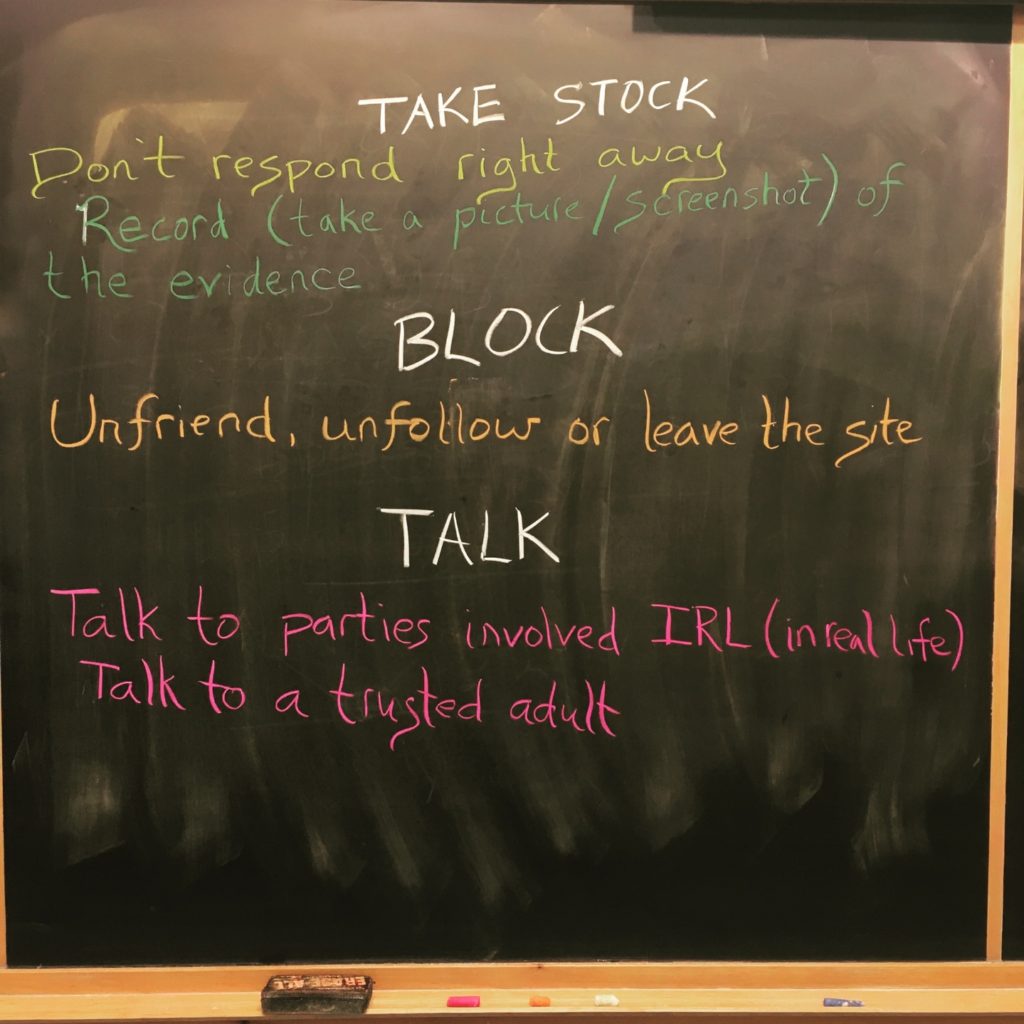
The sixth-grade class just completed a unit on cyberbullying and digital drama. Students learned a memorable strategy to call upon should they ever become the target of cyberbullying themselves. Take Stock, Block, Talk is easy to remember, and will help students avoid feeling powerless should they ever be scared, hurt, or frightened by something that occurs online.
TAKE STOCK. Students learned that if something uncomfortable happens to them online, it is best not to react immediately. Sometimes bullies are simply trying to elicit a response, and by responding to mean behavior (especially with another mean behavior) they might be giving the bully exactly what they want. Plus, responding might get them into trouble. Students have learned that online encounters are sometimes misunderstood (especially since facial expressions and social cues are missing); some people may not even realize they’ve been hurtful online. However, students are also being taught that they should never ignore online harassment. If they do feel threatened, they should take a screenshot of the evidence and report bad behavior.
BLOCK. It is simple to block, unfriend, or leave the site where abuse takes place. Students learn that they do not have to subject themselves to cruelty online and, in fact, it is detrimental to their online reputations to maintain an online connection with someone who spreads cruelty.
TALK. Reaching out to a friend, or even better, a trusted adult to talk about anything uncomfortable online is the most important step. Adults can help assess the danger and, if needed, involve the school, or in serious situations, local law enforcement.
FAMILY TIP: For information on how to keep kids safe online, visit www.cyberwise.org
Grade 7 Cyber Civics
The seventh-grade Cyber Civics year focuses on information literacy and teaches students how to find, retrieve, analyze, and use online information. We have just finished a unit on online privacy. One of my favorite lessons to teach to students is how to create strong passwords. Passwords are our first line of defense when it comes to protecting our online privacy. In fact, research shows that up to 80% of online data breaches are due to stolen or weak passwords.
A GREAT PASSWORD SHOULD:
• Be at least 8 characters in length.
• Should include a combination of lower and uppercase letters, symbols, and numbers.
• Never include personal information.
• Never include the name of family members, friends or pets.
• Never include sequences, such as: abcde or 12345.
• Never include a dictionary word (unless a letter has been changed into a symbol).
• Be changed regularly—at least every six months.
Seventh graders learned that a mnemonic device, a learning technique that aids information retention, comes from an ancient Greek word meaning “of memory, or relating to memory.” They have been practicing using mnemonic devices to create and remember strong, secure passwords. Can you guess my mnemonic? g0W!Ld(@t$!
FAMILY TIP: There are some rules to follow when it comes to making great passwords. For example, although we should never share a password with a friend, it is important that parents know children’s passwords. Because children are minors, and parents usually own and/or pay for their smartphones, tablets, and/or computers, it is a matter of security for parents to be able to access your children’s information. A good rule of thumb is for every family member to keep a password log at home that can be accessed by others in case of emergency.
Grade 8 Cyber Civics
In eighth grade, our focus is on media literacy for positive participation. Students just began a unit on visual literacy. The media our children see play a powerful role in creating and perpetuating stereotypes. TV, videos, movies, video games, and more often depict people in overly simplified ways and digital technologies make it easier than ever to share and perpetuate these notions. Teaching students to “see” stereotypes help them notice missing perspectives and viewpoints in the media they consume and, one day, possibly produce. Visual literacy is an extension of media literacy. Visual literacy teaches students how to read, write, and create visual images. Because so much of the media that young people interact with today is visual–think Snapchat, Instagram, YouTube, online news, blogs, games, and more–learning how to “read” the imagery they see is an essential 21st-century skill.
FAMILY TIP: Media stereotypes extend well beyond gender. Different ethnic, racial, age and other groups are often depicted in overly-simplified and, sometimes, unfair ways on TV, in videos, books, movies, and more. When watching a movie or reading a book, have a frank and open discussion about any stereotypical representations you observe.
Remember, it takes a village to raise thoughtful, ethical, and smart digital citizens!